We drove the all-new Golf GTI Mark 8.5 at NATRAX in Indore, India’s premier automotive test facility, and it feels exactly like it always has. Urgent, involving, and deeply satisfying. The question going in was simple: Does the latest GTI still justify its cult status, or has it gone soft chasing a broader audience?
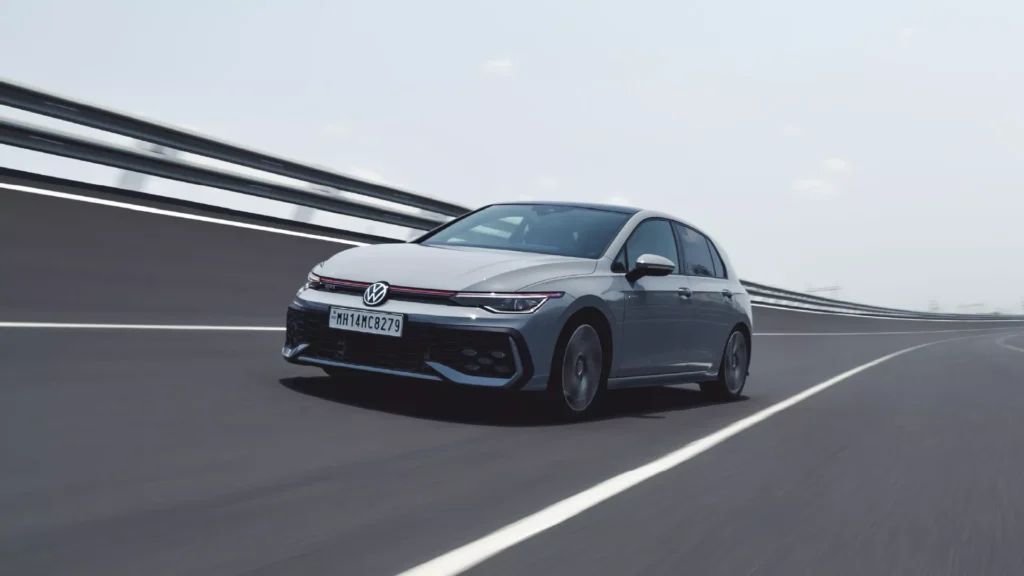
After a full session on the high-speed oval and the handling track, the answer is clear. This car still has it.
A Legacy Worth Understanding
The GTI didn’t start as a performance car. It started as a quiet plan.
- The Golf was introduced in 1974 to replace the wildly successful Beetle
- A small team of engineers drew up a secret proposal for a sportier, performance-oriented version
- Originally conceived as a Grand Touring variant, the GT in GTI stands for Gran Turismo Iniezione
- The GTI Mark 1 arrived in 1976, with VW planning a modest production run of just 5,000 units
- They had no idea what they were creating. By the time Mark 1 production ended, over 450,000 GTIs had been sold
- Mark 2, 3, 4, 5, 6, 7, and 8 followed, every generation a hit, each refining rather than reinventing
- The red stripe across the grille, the tartan seats, the golf ball gear knob, all GTI signatures from the very beginning
- The tartan seat design was introduced by a woman who led the original design team, the same person responsible for the red stripe and much of what became the GTI’s cult identity
What we have today is the Mark 8.5, a facelift over the Mark 8, with meaningful updates in design and technology. The dimensions haven’t changed. But enough has to make it feel new.
Design: Stylish Yet Purposeful
The GTI doesn’t shout. It never has. But look closely, and the details earn their place.
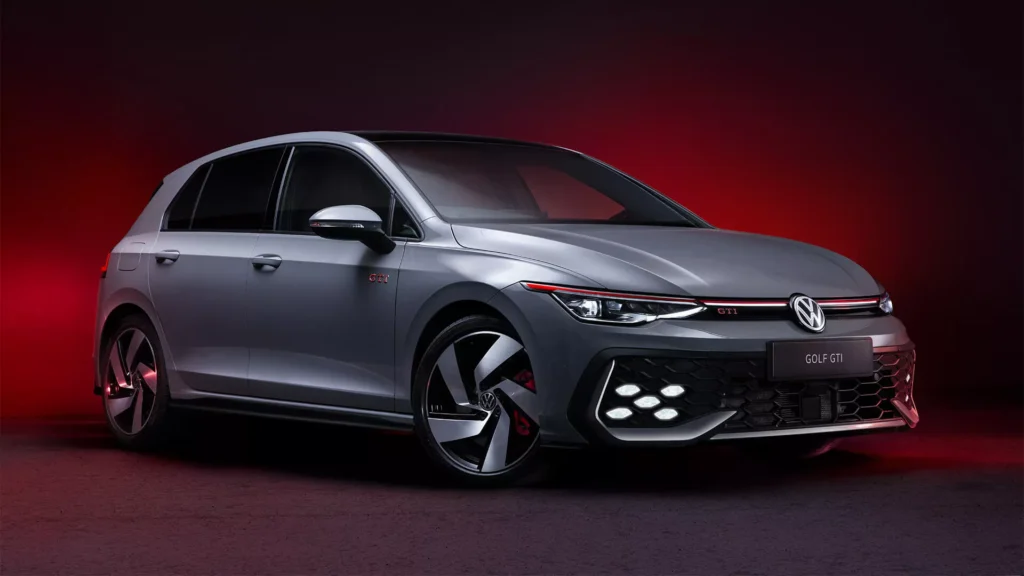
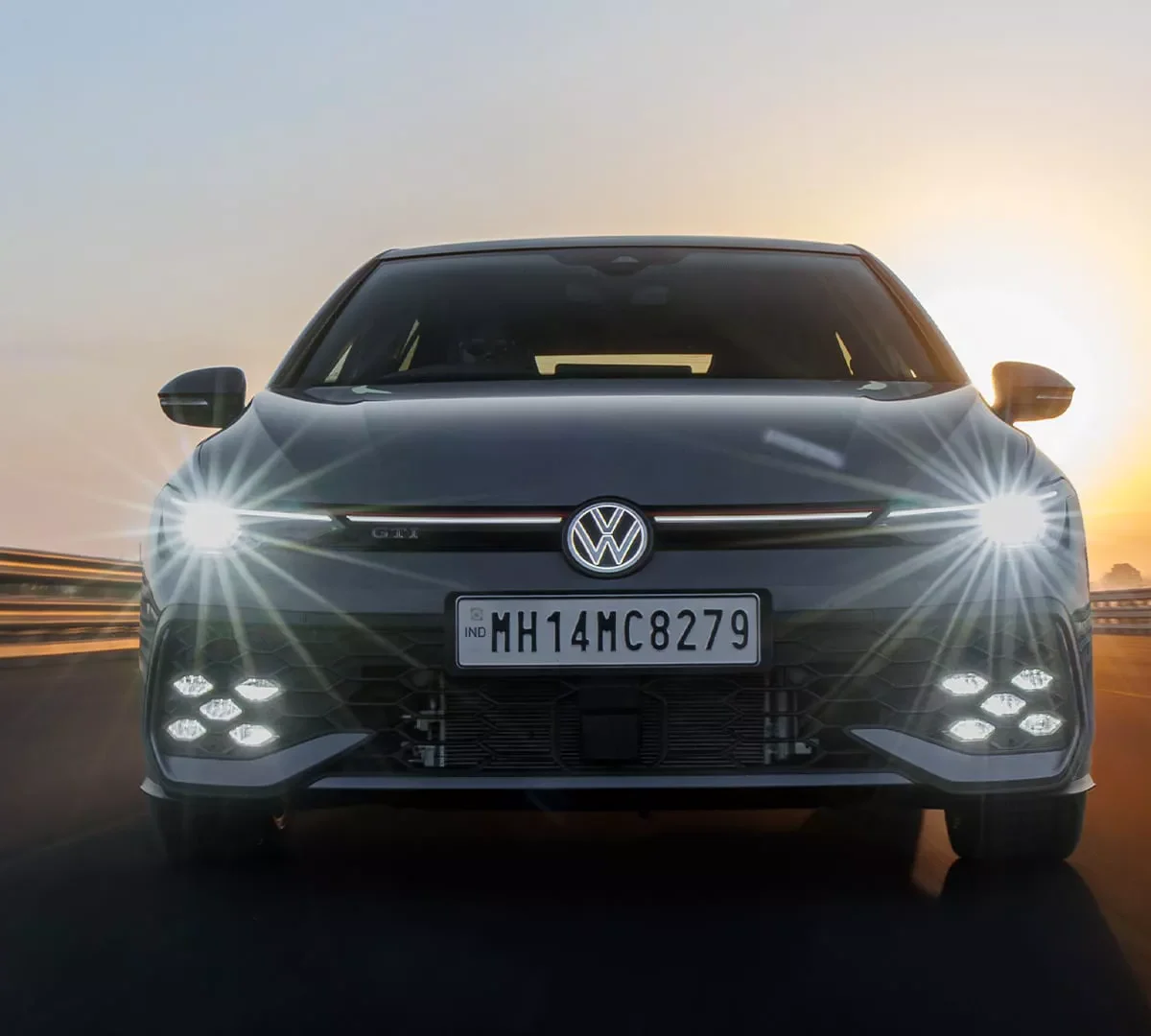
- Completely redesigned headlamps with Volkswagen’s IQ.Light intelligent LED system
- Continuous DRL strip running across the front, clean and sharp
- The iconic red stripe through the grille is still here, still red, now unbroken end to end
- New illuminated VW logo, a first for the Golf, and likely to become a popular aftermarket spec across the range
- Honeycomb grille pattern below, large radiator opening visible at the base
- 18-inch alloy wheels, the recommended Monsoon-style circular design from Mark 5 remains a personal favourite; this generation’s wheel is clean but not quite as iconic
- GTI badge on the front quarter, integrated in red
- Low side skirts, lowered ride height, it sits with purpose
- Turn indicators are integrated neatly into the door mirrors
- Rear spoiler with integrated lighting, subtle lip, not aggressive
- Shark fin antenna on the roof, rear wiper discreetly integrated
- Real chrome dual exhaust tips, both barrels functional, not decorative
- GTI badge at the rear, nothing else, no Golf badge, no further explanation needed
The Club Sport variant adds diffuser elements at the rear. Our car, the standard GTI, is cleaner, and honestly no less handsome for it.
Interior: Familiar, Focused, and Fixed
Climb in and sit low. This is a driver’s car, and the seating position tells you immediately.
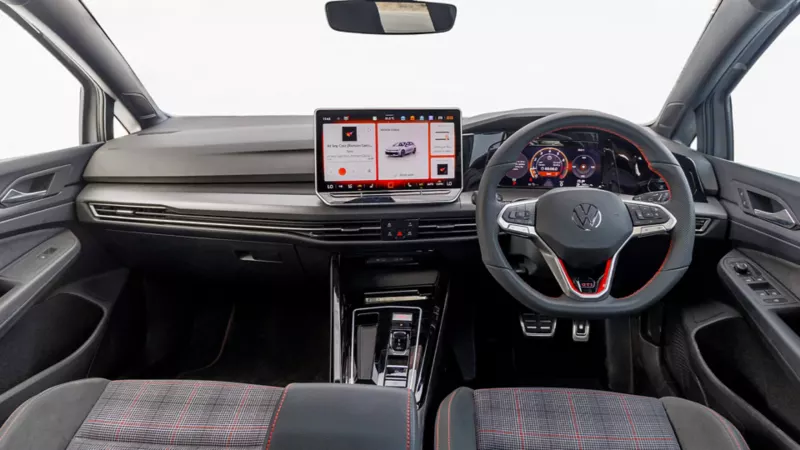
- Black cabin throughout with red accents, GTI badge on the steering wheel, red stitching on the flat-bottom rim
- Tartan seats are back, and they are magnificent, high-quality fabric, sporty bolstering, high headrests with GTI embossing
- Physical steering wheel buttons have returned after the previous generation’s touch-sensitive disaster, a very welcome correction
- Progressive steering system as standard, two full rotations lock to lock, which pays dividends on track and in tight city situations
- 12.9-inch central touchscreen, crisp, bright, responsive, readable even in strong sunlight
- 10.25-inch digital instrument cluster, compact but legible; no heads-up display, which is a minor miss
- Three-zone climate control with touch sliders below the screen
- IDA voice assistant integrated into the infotainment, works well, feels natural
- Carbon fibre finish trim pieces throughout
- Wireless charging pad hidden beneath a sliding storage panel in the centre console
- Two USB-C ports up front, two more in the rear
- Seven-speaker audio system, punchy and sufficient, not audiophile-grade
- Seven airbags as standard
- Openable sunroof, not panoramic, but a proper size
One significant complaint: this generation comes only with a DSG automatic. The manual gearbox, with its legendary golf ball gear knob, is gone. For many of us, that’s a real loss. The paddles help, but they’re not the same.
Rear space is honest. Children will be comfortable. Adults on long journeys will manage. It is what it is for a compact hatchback.
Powertrain: 2.0 Litres, 261 Horses, All to the Front
The GTI’s engine has always punched well above its displacement, and this one continues that tradition.
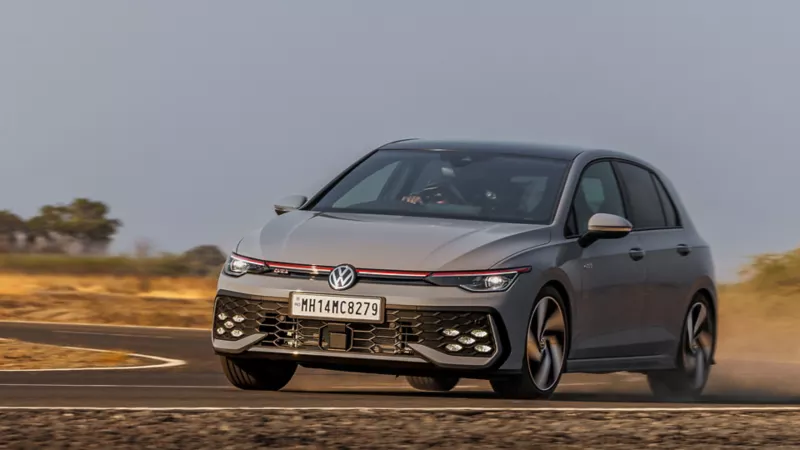
- 2.0-litre turbocharged TSI four-cylinder petrol engine
- 261 hp and 370 Nm of torque
- 0–100 kmph claimed in 5.9 seconds
- Top speed electronically limited to 267 kmph
- Front-wheel drive, all power through the front axle
- 7-speed DSG dual-clutch automatic transmission
- XDS electronic differential lock system as standard
That last point matters more than it sounds. Here’s what XDS actually does: in a fast corner, the inside front wheel naturally wants to spin more than the outside. On a front-wheel drive car with this much power, that spells understeer. XDS detects this, selectively brakes the inside wheel, and effectively mimics the behaviour of a limited-slip differential. The result is a front-wheel drive car that corners with far more composure and aggression than the numbers suggest it should.
On track at NATRAX, this system was the difference between a competent hot hatch and something genuinely special.
What We Felt Driving It
The high-speed oval at NATRAX runs at up to 50 degrees of banking; the steepest sections feel genuinely like a NASCAR circuit. Centrifugal force does the work; steering input becomes minimal. We ran two full laps above 267 kmph in the morning session before the driving day began.
Key impressions from our drive:
- High-speed stability is exceptional, speed builds without drama, without nervousness
- The car held 267 kmph for two full laps with zero overheating, no brake fade, no loss of composure
- Progressive steering is light and sensitive at speed, demands respect and careful inputs above 200 kmph
- At lower speeds and on the handling track, the same steering feels natural and engaging
- Cornering with XDS engaged is a revelation for a front-wheel drive car, with minimal understeer and maximum confidence
- Braking is strong and consistent throughout the session
- Seats hold well under hard cornering without feeling punishing
- DSG shifts are fast and smooth; paddles work well, but the lack of manual remains a genuine disappointment
- Suspension could not be assessed fully on these smooth test surfaces; that verdict will come on real Indian roads
Two consistent observations from our time in the car: this is a vehicle that rewards being pushed, and it is also completely livable as a daily driver. The steering weight is softer than previous generations, deliberately so, to make it accessible in traffic and city use. That’s the right call. You don’t lose the character; you gain usability.
Verdict
The Golf GTI Mark 8.5 doesn’t reinvent fifty years of heritage. It refines it, and that’s exactly the right move.
- The driving experience remains the benchmark in the hot hatch segment
- XDS technology makes the front-wheel drive dynamics genuinely exceptional
- Interior quality, technology, and comfort are a clear step forward
- The absence of a manual gearbox is a real and meaningful loss for enthusiasts
- At an ex-showroom price of around ₹50-₹53 lakh, it asks a serious question and answers it convincingly
This isn’t just a Golf with a red stripe. It’s fifty years of knowing exactly what a driver’s car should be, distilled into a package that still, after all this time, feels like nothing else on sale.